It was fun to write my ChatGPT energy post because the science of energy and how it’s used is one of the most interesting things to read and write about. Few topics give you as much systematic understanding of human society as energy. You should aim to become ‘energy literate’ and have a solid grasp of what energy is, where it comes from, how it’s used, and what the future of energy might look like.
It’s especially important to have a bird’s eye view of our energy system as a whole. Merely reporting how many kilowatt-hours something consumes is almost never useful if you don’t have a sense of how much energy society uses across different sectors and how much of it is green. Trying to understand technology or institutions by learning how many kilowatt-hours or households’ worth of energy they use, without context, is like reading about someone spending $25 on a nice dinner and trying to judge how bad a financial decision it was for them without knowing anything about their income, savings, where they live, or their broader social situation. Reading a headline like “A new report reveals that ChatGPT exorbitantly consumes 17,000 times more electricity compared to the average US household per day” as someone who’s basically energy literate has the same feel as reading a headline like “Someone spent $150 on a pair of headphones! Was this the right thing to do?” opening the article, and seeing long debates saying things like “$150 is a lot more money than you’d have to pay to listen to music on the radio” or “Some people are saying that some people should save more money.” Reading these, you start to feel like you’re going a little crazy, because the author never actually puts the value in context, and just reports it as if the number “$150” tells you everything you need to know about how financially responsible this person is. You should be very skeptical of reports on energy that don’t contextualize the number.
Facts to learn§
In your learning about energy, you should prioritize understanding:
What a joule, watt, and watt-hour actually are and represent. That energy in the everyday sense is just the measurement of something’s ability to apply a force for a distance, and the value of the energy is the force it can apply multiplied by the distance. Something with 16 joules of energy can apply an 8 Newton force for 2 meters, or a 4 Newton force for 4 meters, or a 16 Newton force for 1 meter, etc.
That energy is conserved. It is never created or destroyed in classical physics (relativity complicates this). It is only transferred to different objects and transformed into different types of energy.
That we can track all energy using Sankey diagrams like the one below. We could make a more extreme diagram tracking all energy we from its ultimate origin in the sun (or Earth’s core), through Earth’s systems, where it’s captured to be used by humans, how it’s transmitted through human society, to where it’s eventually dissipated as heat.
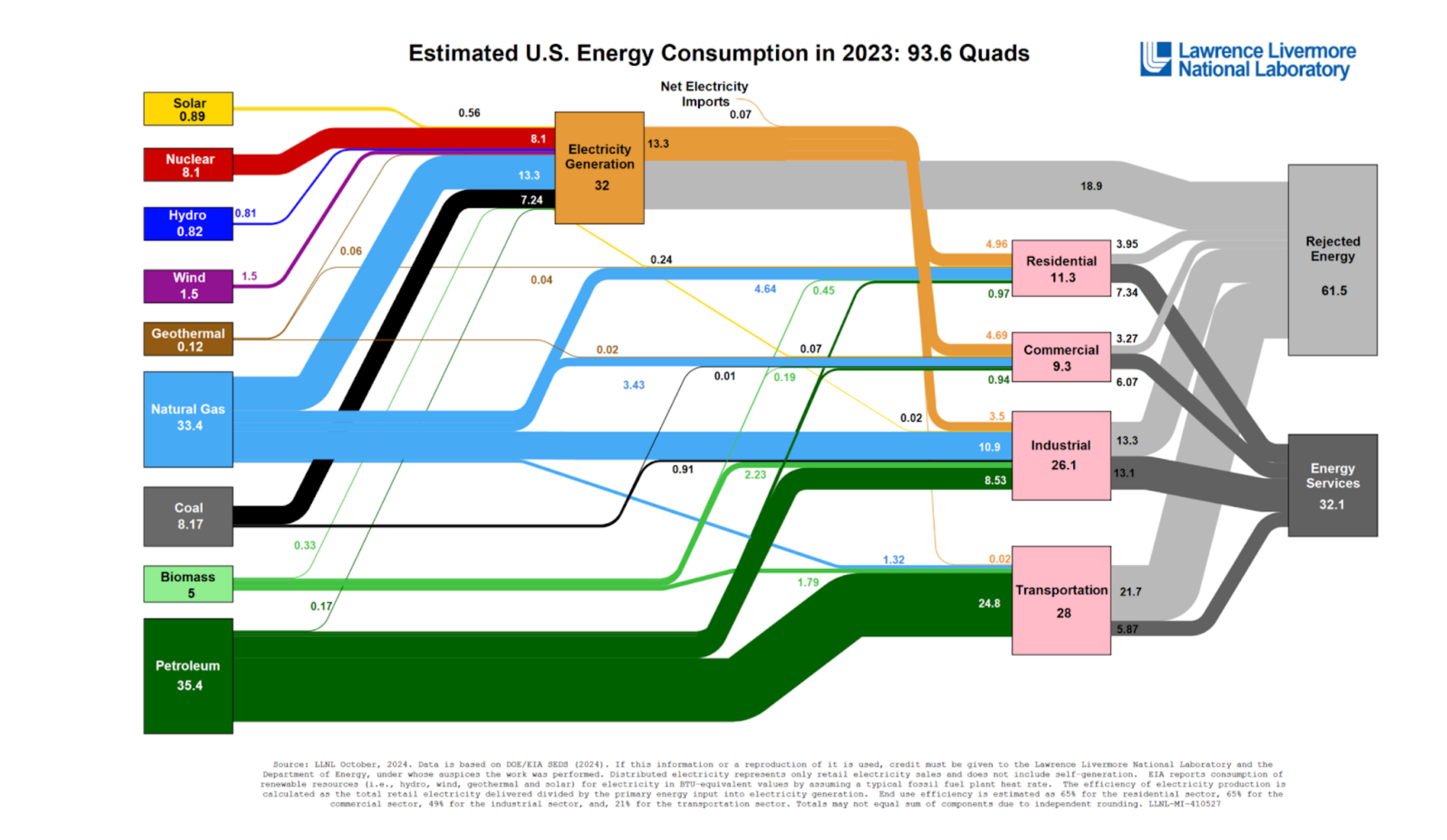
Lots of big overall numbers of how much energy is being used by different sectors, and how much is available from each way we currently generate energy.
Rough guesses at what the future of energy production looks like.
How energy use relates to climate change.
The scientific consensus on climate change and different expected futures based on our emissions.
Resources§
I’ve shared these in the order I’d engage with them if I were starting to read about energy.
Audio: The Great Courses - The Science of Energy
If I could assign everyone one place to start learning about energy from scratch, this would be it. The lectures are simple and approachable and get at all the most important facts about energy use.
Book: Sustainable Energy - without the hot air
One of the best popular science books on anything. Designed to help you build general energy literacy. This is a holy text for me. I see it as a basically perfect model to aspire to for clear science writing and communication.
Blog post: Construction Physics has a great “energy cheat sheet” with important high level facts about energy use.
Lots of Wikipedia pages. Start with World Energy Supply and Consumption, Energy in the United States (or your country if you’re not in the US), then read profiles of each way of generating energy, then the article on the most recent IPCC report, and branch off from there in directions you’re interested in.
Book: Vaclav Smil’s Energy and Civilization (and most of his books).
This is an amazing book rewriting all human history as a process of learning to capture and more efficiently use more and more energy, and almost all events being guided by that. Many of Vaclav Smil’s books are written to give you big overview understandings of energy. He can be very dry but worth reading.
A good summary of the most recent IPCC Report.
The Wikipedia page is a good place to start. You should have a clear understanding of the Shared Socioeconomic Pathways and probabilities experts give on each pathway happening.
Books: The Prize and The Quest by Daniel Yergen.
Great popular history/science books on how so much of geopolitics has been determined and motivated by access to energy.
YouTube: I used to teach high school physics and will plug my YouTube videos about energy. There are a lot of great YouTube channels focused on energy and physics.
Report: Founders Pledge report on strategies for climate philanthropy in 2025. One of the most informative documents on climate and energy that I’ve read.