I’ve gotten a lot of mileage out of declaring over and over again that the massive moral panic over the climate and water impacts of individual chatbot prompts is ridiculous and based on wild simple misunderstandings that take a few minutes of googling to disprove. A few people have commented along the lines of “This makes me wonder what other big widely talked about catastrophes are fake.” I figured it’d be fun to start a public list here. Feel free to message me with any, either here or at AndyMasley@gmail.com.
I want to avoid three categories of fake catastrophe here:
Things that only fringe people believe are catastrophes, like vaccines being worse than COVID. You should be able to go to a party of educated adults and find at least a few people who believe them, and when they talk about them others just nod along without questioning them.
Things you can only believe aren’t catastrophes if you have a very specific political or religious outlook. I want to avoid things like “It’s bad that people are less religious now” because that’s too dependent on the values of the person speaking.
Things without a clear expert consensus. For example, while I enjoyed The Economists’ coverage of the “myth” of the decoupling of wages and productivity, this is actually pretty contentious, and there are a lot of good counter-arguments to how they present it.
I’ll end with some things that I expected to be fake, but when I looked into them turned out to be real.
Fake catastrophes§
“More people in the US are getting cancer”§
The total rate of cancer in the US has increased since the year 2000, but this is just due to the population being older on average now. If you adjust for age, incidents rates of cancer fell by 5.7% between 2000 and 2021.
“People’s attention spans are getting shorter”§
“Cell phones/5G/Wifi cause cancer”§
This one feels like it’s at the edge of being fringe, but I’ve been to multiple parties where educated people bring it up as if it’s real, and others nod along. There are multiple ways to go about showing that it’s wrong:
As mentioned above, the average US cancer rate has actually dropped once you adjust for age since 2000. In this time, everyone has completely surrounded themselves with cell phones and wifi. It would be weird if every last one of us had each adopted some new habit that carried a significantly increased risk of cancer, but the cancer rate had also significantly dropped.
There are two ways radiation causes cancer. Neither makes cell phone radiation look like it can harm us:
Ionizing atoms in DNA molecules (knocking electrons out of their orbits). To knock electrons out of place, waves need to each carry a specific minimum amount of energy (I explain this a lot more in my physics YouTube series here) that radio waves fall way, way, way short of. If they don’t carry that minimum amount of energy, they don’t affect the electron’s positions at all. They can oscillate them, but they can’t break them free. Wifi, cell phones, and 5G are all completely, totally lacking in this mechanism.
Heating tissue enough to damage DNA. If you heat cells enough, you can denature proteins and damage DNA structures. This is why severe burns increase cancer risk, and is why we can get cancer from UV rays. But this requires significant heating. Cell phone radiation is so weak that the maximum heating it can cause is a fraction of a degree, less than the temperature increase from holding the phone against your face and absorbing the battery heat, going outside on a warm day, or having a mild fever. Your body’s normal ability to regulate temperature handles changes way, way larger than anything Wi-Fi or 5G can produce. The FCC imposes safety limits on cell phones, and they’re designed to make sure that any heating stays below 1°C even under worst-case conditions. Real-world exposure to heat from cell phones is usually way below those limits.
The only scientifically confirmed way radio waves interact with your body is by heating it a little bit. This is the same principle that makes a microwave oven work, but the radiation from your cell phone is about 100,000 times weaker than your microwave, and unlike your microwave, it’s not concentrated on any one location.
The actual temperature increase in your head from a phone call is a tiny, tiny fraction of a degree. It’s less than the temperature fluctuation you get from drinking a cup of coffee or walking outside on a warm day. If heating at this level were a concern, we’d be much more significantly damaged by hot showers.
Your body has robust systems for handling these small temperature changes. It does this all day, every day. The heating hypothesis just doesn’t really make any sense.
Climate and energy§
“We’re going to run out of fossil fuels”§
Basically all forecasts now seem to imply that it’s way more likely that we’ll hit a peak in fossil fuel demand before we hit a peak in fossil fuel supply. This is good. The main bad thing about fossil fuels is that they cause climate change. The fact that they’re finite is a secondary bad, and burning all of them would be disastrous for the climate.
“Wind farms kill birds”§
A reader convinced me this is actually more of a problem than I thought, see his comment here.
They do, but not very many relative to other things we do.
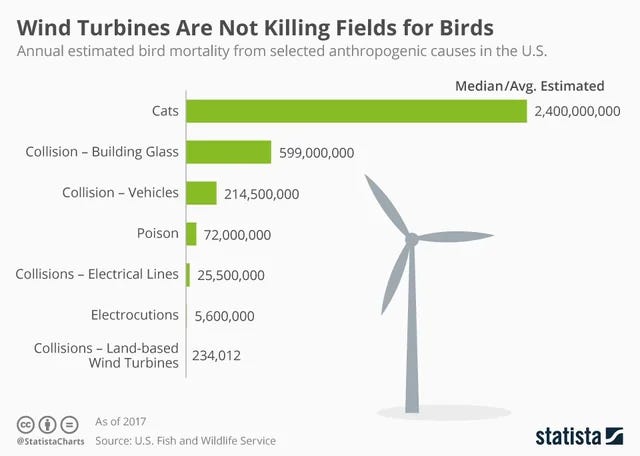
Two thirds of bird species in North American are at risk of extinction due to climate change. If you want to help birds, build more turbines.
“Planes are significantly worse for the climate than driving the same distance”§
If you compare the emissions you cause by taking a plane ride (dividing the emissions of the plane by the passengers) it’s often comparable to driving solo for the same distance. The reason why plane rides add so much to our carbon emissions is that they cause us to travel way, way farther distances than we would have otherwise, not that they’re drastically worse per mile. In the past year I’ve taken a few plane trips that were thousands of miles (I flew way more than normal). I would not have chosen to drive solo this far to get to the same place. If I had, my emissions would have been about the same.
I regularly travel between DC and Massachusetts for holidays. If I drive, my emissions are about 120 kg of CO211 I own a 2015 Corolla which gets ~32 MPG highway. US average emissions per gallon is 8.887 kg CO₂/gal. Trip is ~440 miles. (440 miles) x (1 gallons / 32 miles) x (8.887 kg CO2 / gallons) = 122 kg CO2. (440,000 ChatGPT prompts!). If I fly, my emissions (diving the plane emissions by the number of passengers) are about 110 kg CO222 Emissions for short-haul flights average 154 g CO2 per passenger km. It’s ~700 km by air from DC to Boston.. I usually opt for the train, since it emits way less, but I should definitely not choose to drive for the sake of the climate. That’s the worst option here!
Planes pollute at higher altitudes. The effects of CO2 emissions doesn’t seem to change much based on the altitude they happen at. Some argue that the main bad effects of flying is in their non-CO2 pollutants like nitrogen oxides (NOx), water vapor, contrails, and cirrus cloud formation, which can have a warming effect 2-4 times greater than CO2 emissions alone. But the warming effects of all these other emissions is extremely short-lived. CO2 remains in the air and warms the atmosphere for centuries to millennia, but the warming caused by NOx lasts at most a few months if we consider its ozone effects, water vapor’s warming effects last up to a few years, and effects of contrails last for about a day. These very short warming effects aren’t really what matter for climate change. All the worst effects of climate are in the medium to longterm as more and more CO2 builds up in the atmosphere.
If we break down the immediate warming effects caused by plane emissions on a given day:
57% is caused by contrails
34% is caused by CO2
17% is caused by NOx
Though we’re uncertain about the exact magnitudes. But it seems possible to eliminate contrail emissions from planes for very little money. If we do this, the immediate warming effects of flying will mostly come from CO2 again, and flying becomes pretty comparable to solo driving even if we’re just considering the short-term effects. Unlike driving, flying also doesn’t significantly contribute more to local air pollution that people actually breathe.
If we look at the carbon footprint per kilometer traveled for different vehicles, gas cars and planes don’t look too different from each other, especially not compared to many other options like electric cars and trains:
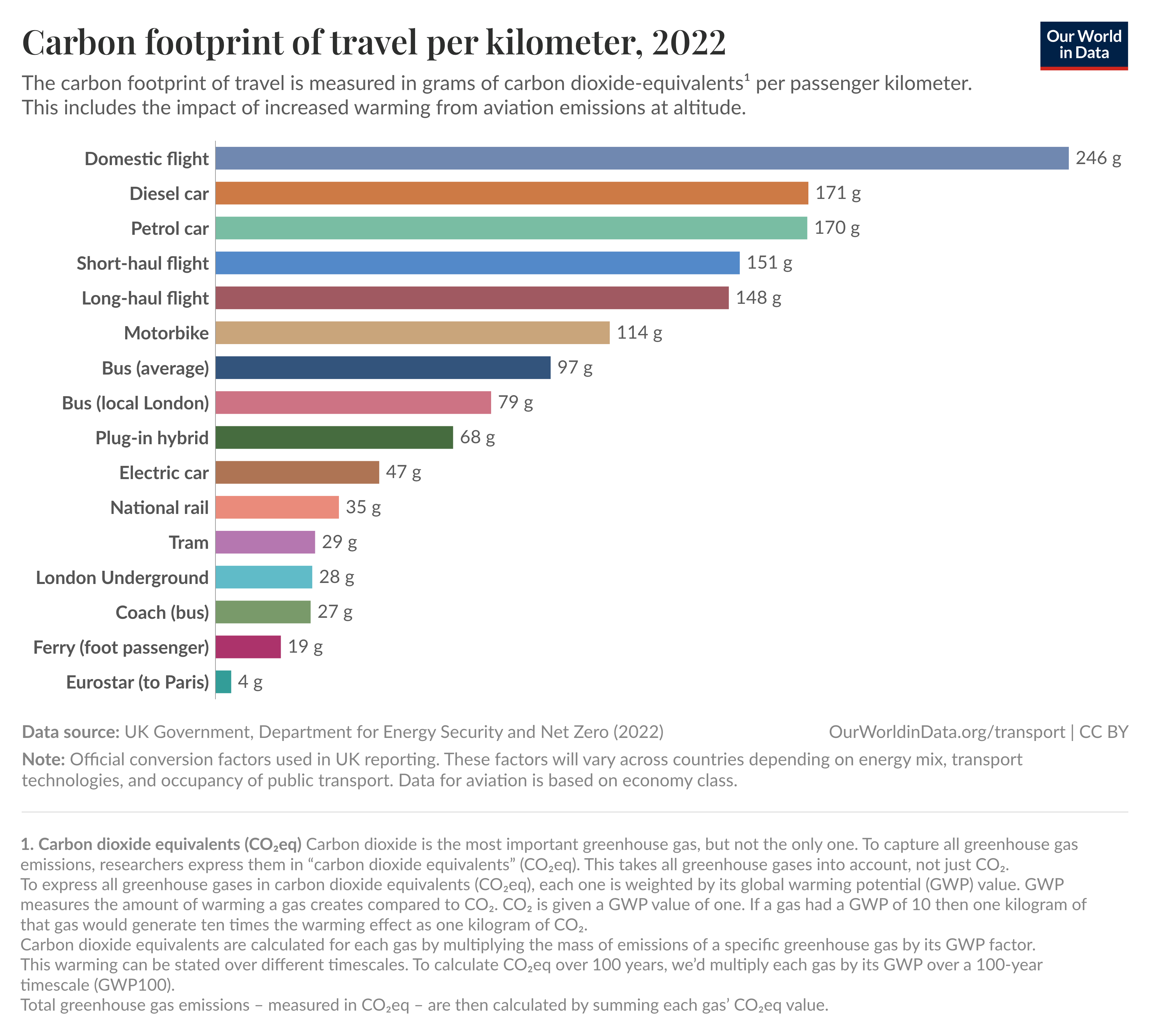
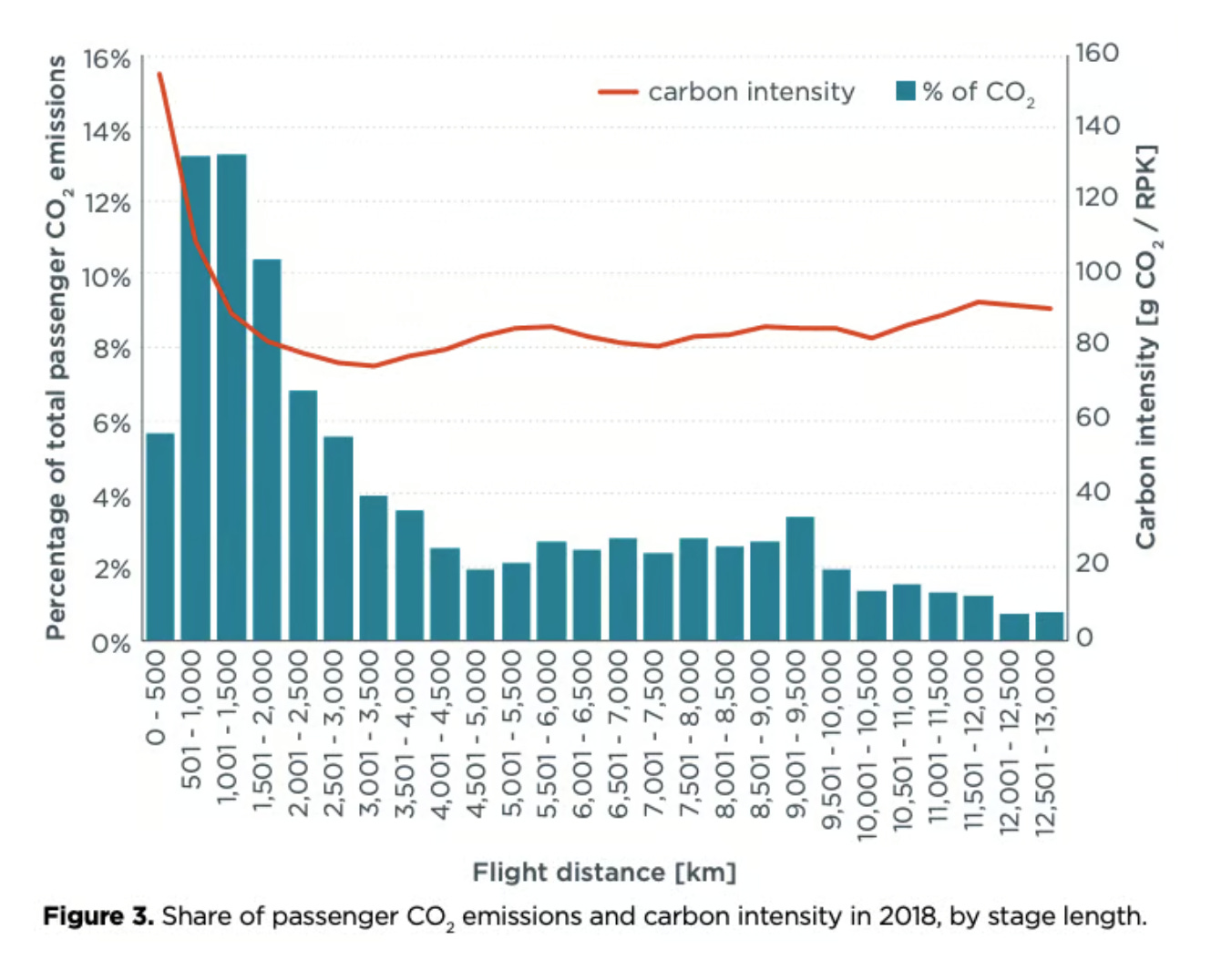
On this graph “Domestic flights” are considered very short (as you can tell, the graph was made in the UK, so their “domestic flights” are all extremely short), whereas short and long-haul flights are longer. The carbon intensity per mile actually drops off a lot for longer flights:
I tried looking at the trade-off you make in CO2 saved per increased risk of injury and death when you choose to drive over taking a domestic flight, but the absolute risk of injury and death were both still so absolutely low while driving that it didn’t come out to much. Even if you were completely cutting all your CO2 at this rate of risk it wouldn’t add up to too much additional injury risk or death per year. Basically, if flying is more comfortable to you than driving, and those are your only options, and you would definitely make the trip either way, then if it’s a longer or medium flight (over ~400 miles) you should definitely fly, and if it’s a shorter flight the slight increase in emissions might still be worth the trade-off. It’s not a serious disaster. Obviously, if you have the option to take the train, just do that! I’m lucky to live in the Acela corridor so this is an easy choice for me. If you’re driving with other people or in an electric car, driving will basically always be better than air travel.
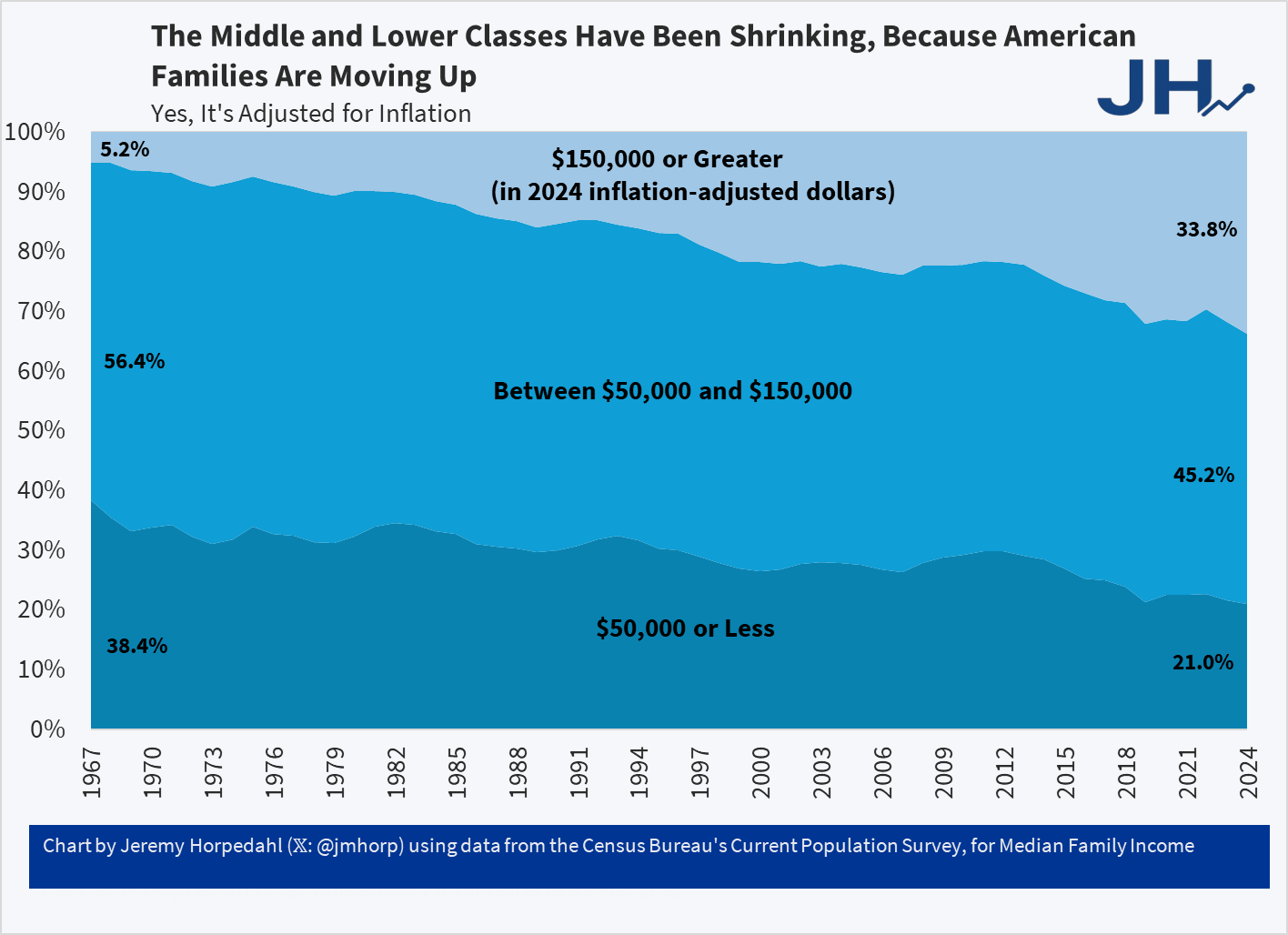
“The US middle class is disappearing”§
Yes, because they’re all getting too wealthy to qualify as middle class.
“Using AI makes people less intelligent (it creates a ‘cognitive debt’)”§
If you use AI to cheat on an assignment, it is true that you will not learn that assignment well. Your brain will also show less activation while you do it. But some people are going farther to say that this failure to activate your brain somehow makes you less generally intelligent over time. There’s suddenly a lot of worry about “cognitive debt” after an MIT Media Lab study blew up all over the internet. I’m going to pass the mic to the BS Detector here for a full explanation:

“Testosterone levels are plummeting”§
Testosterone levels seem to have fallen. This is an interesting problem, but many reports of how much they’ve fallen wildly exaggerate how much, mostly due to a confusing measurement error.
You may have seen a graph that looks like this on social media:
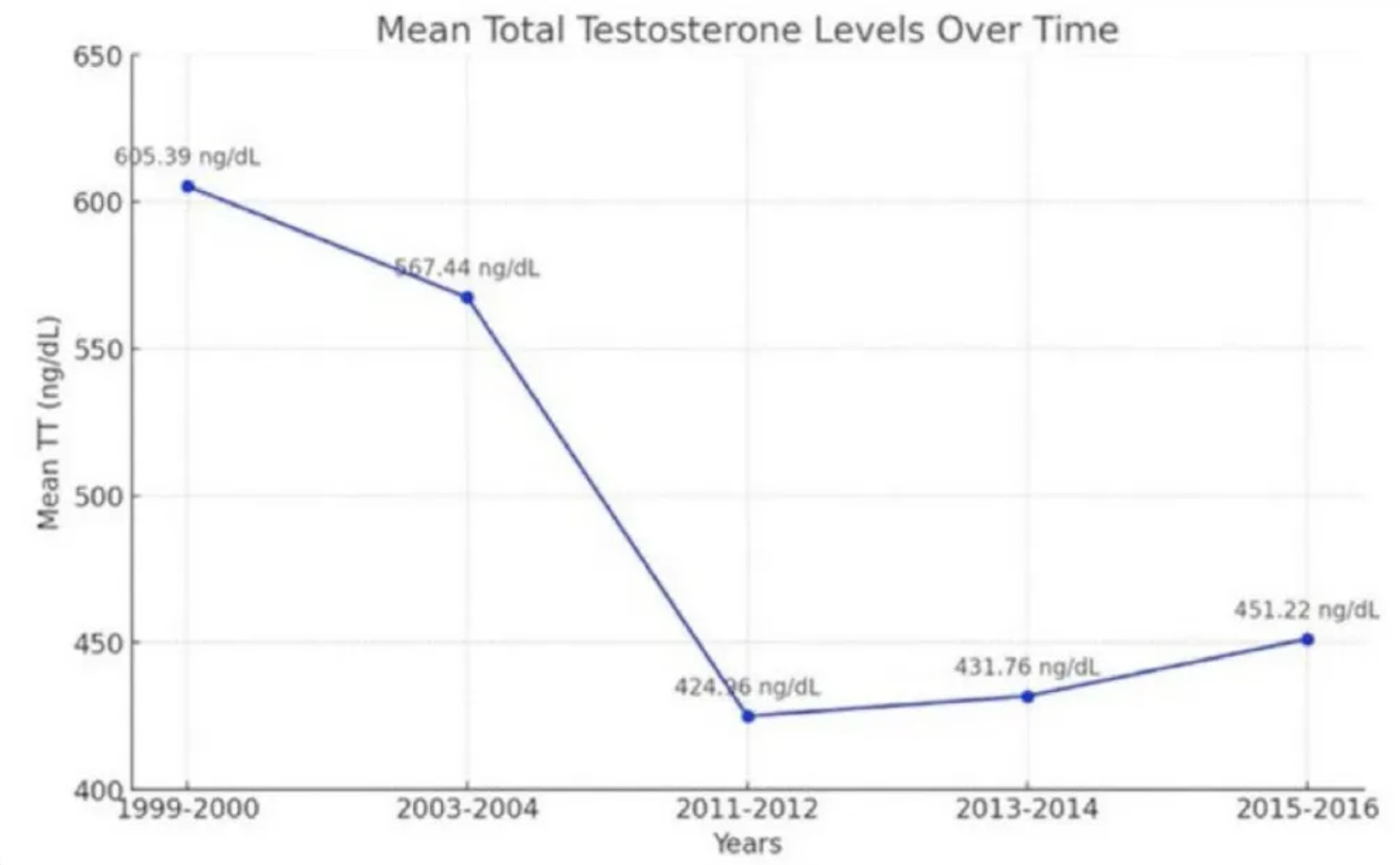
A fall of almost 30% since 2000! Seems alarming! If this were real I’d be concerned. But it’s not. This Substack post is a good rundown of how this is likely the result of a change in how we measure testosterone, not the actual amounts:

See also this Twitter thread. Along the same lines, it seems like the idea of declining sperm counts is currently relying on data that’s too uncertain to draw many conclusions from.
“Landfills will become a major problem as they take up more and more space”§
Landfills aren’t bad for the environment and we have unbelievable amounts of additional space for them relative to the garbage we produce. They’ll basically never be an issue for us.
Think of all the garbage you and everyone you know has thrown away. Even just your personal circle could probably make a moderate mountain of garbage if you combined all your lifetime trash. Now think about all the times you encounter a landfill in your day to day life, as you’re driving around. They seem incredibly rare. That’s a weird mismatch!
It turns out it’s just incredibly easy to dig gigantic, well-contained holes in the ground to throw away centuries’ worth of a city’s trash while going mostly unnoticed. I think humans sometimes underestimate just how small they are compared to the planet. Rob Wiblin has a really great rundown here going into details about just how small of a problem landfills are.
“Seed oils are bad”§
I’m open to considering stuff like seed oils and won’t write off concern about them right away, but the evidence that they’re harmful does in fact seem shockingly bad. Here’s a long roundup of the evidence. Here’s a good (sometimes goofy) video summary of the state of the evidence.
“There’s a new loneliness epidemic”§
Seems pretty uncertain. Americans are reporting spending more time alone, but not reporting being more lonely. See this piece for more.
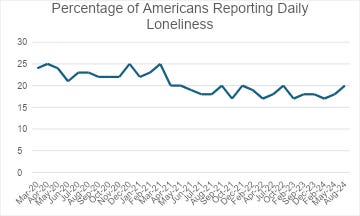
If you break it down by gender and age, it seems like young men are significantly more lonely, but women over 35 are more lonely than men, and US young men are way more lonely than the OECD average, but so are women over 35:
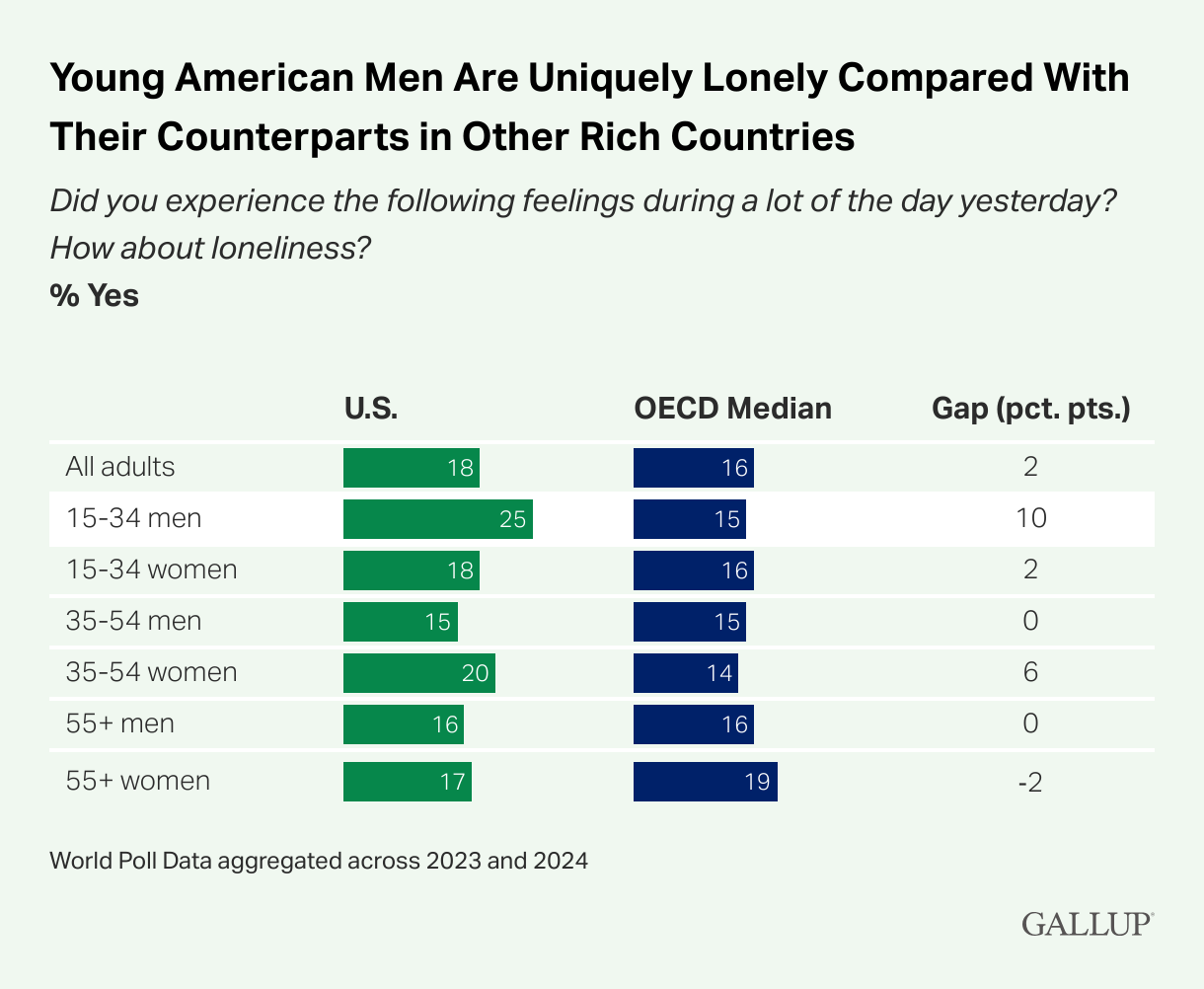
So it seems like we have something like a continuing loneliness problem that mostly affects men between 15-34 and women between 35-54, not a sudden recent epidemic all concentrated in men.
“Kidnapping by strangers is common enough that parents should worry”§
About 350 children are kidnapped by strangers annually in the US. Meanwhile, conservatively, about 75,000 children are kidnapped in the US by one of their parents and are seriously harmed as a result.
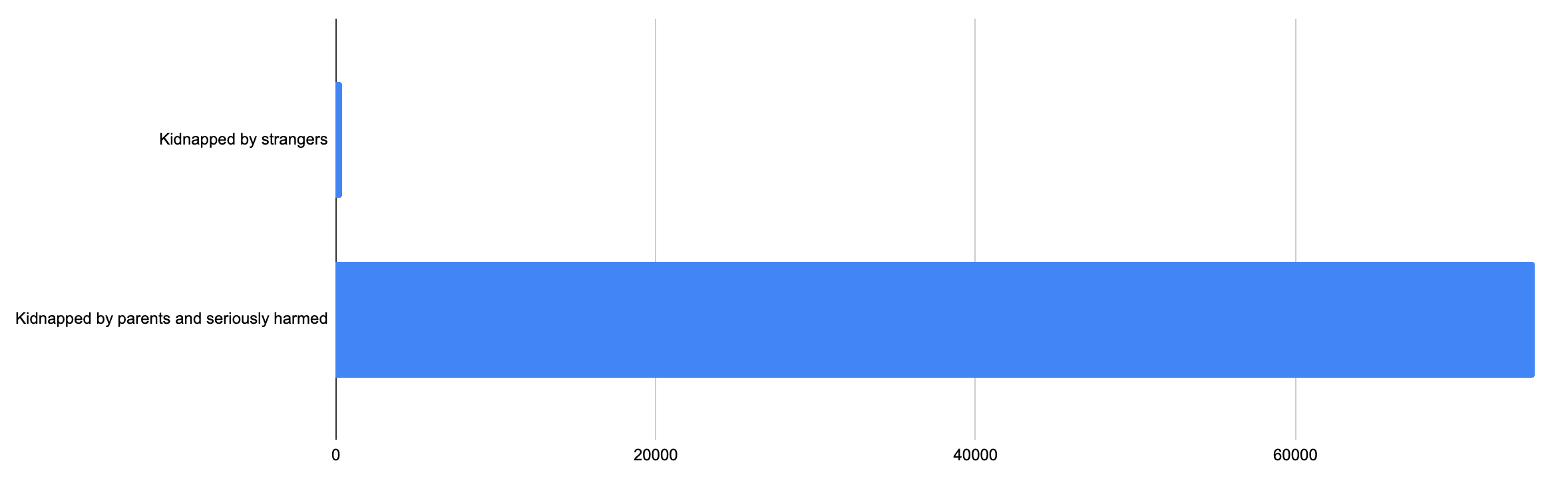
There are 73 million children in the US. In any given year, a kid’s odds of being kidnapped by a stranger are 0.0005%, one in 200,000. Obviously terrible, but way way less common than a lot of people seem to believe.
School-specific misconceptions§
I was a teacher for 7 years and so got into the habit of debunking common myths about American education. The three central ones I would regularly talk about were:
Schools are unsafe
Schools are unfairly funded
Teachers aren’t paid enough (my very very very very least popular take in education circles was that teachers receive adequate pay)
“Schools are dangerous now because of school shootings”§
Back when I was a teacher, I was pretty regularly asked if I was concerned for my safety in schools. School shootings rose significantly from 2015 to 2022:
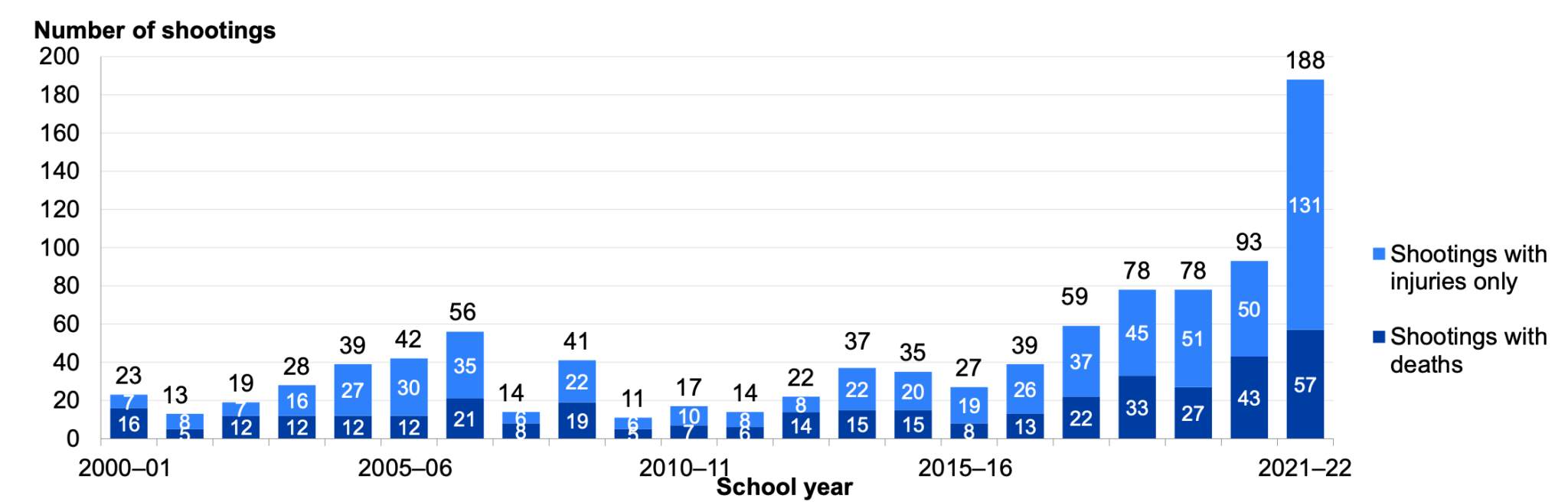
But looked at in the context of overall school violent deaths, things actually mostly hovered around the same number of deaths each year. This graph only goes up to 2015, but the worst year for school shootings on the upper graph wouldn’t be the worst year for total deaths on this graph, because students are also sometimes killed in other ways.
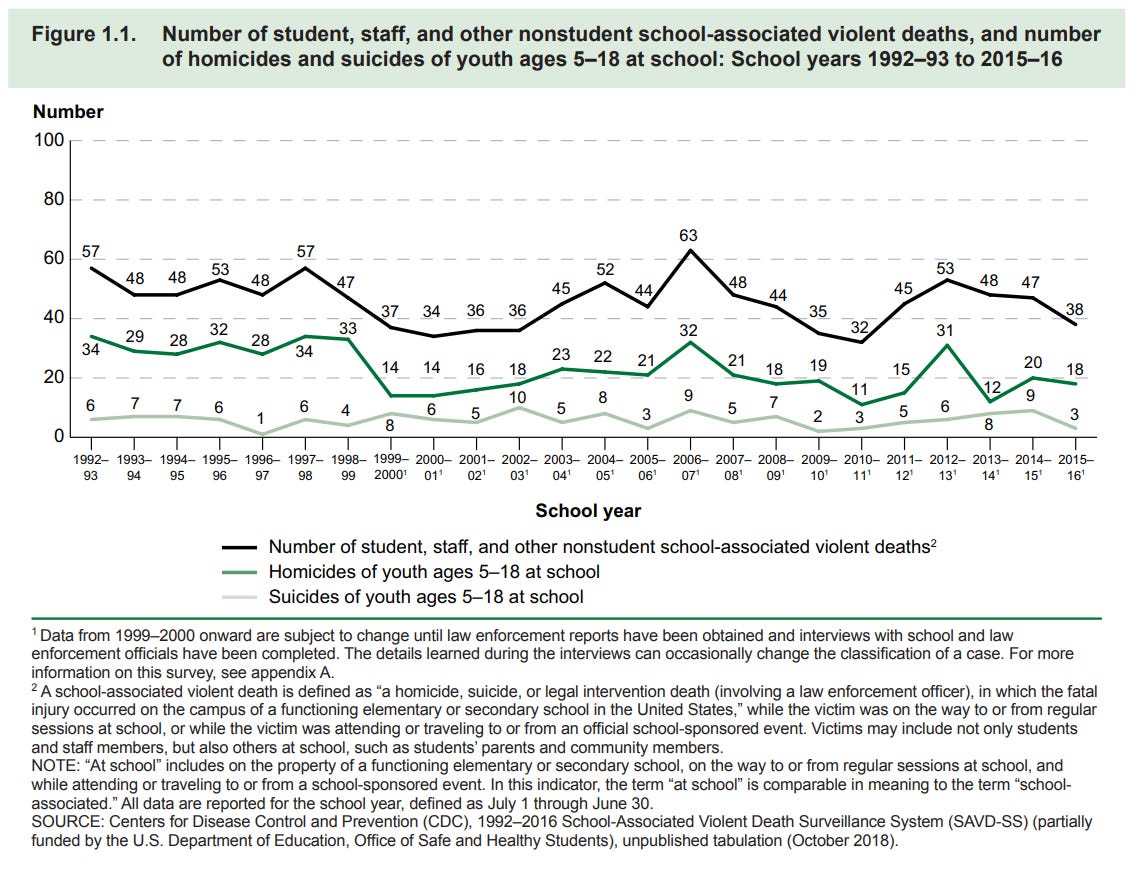
Schools in the 90’s used to be much more physically violent places, to the point that it was common in kids’ cartoons to jokingly show fight scenes like it was a normal part of life. They’ve become significantly less violent since then, and unfortunately outlier shootings are now balancing out the statistics to keep the overall number of people dying roughly the same.
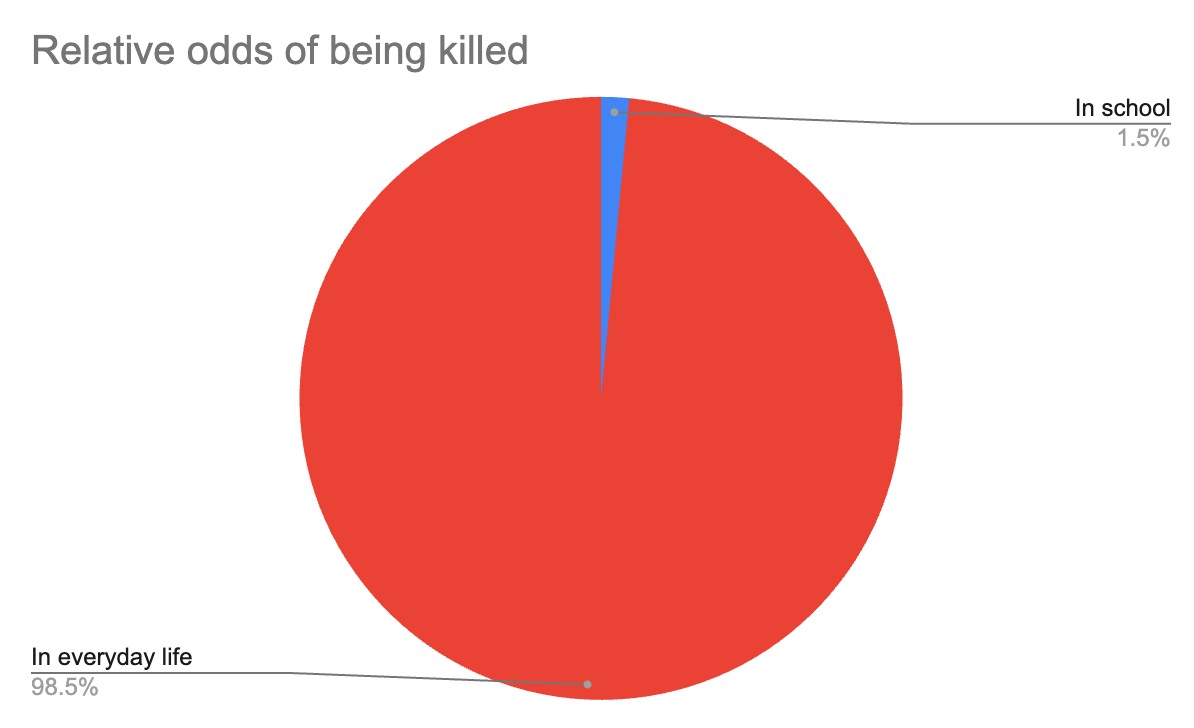
But even in the peak year for school deaths (2006, with 63), my best guess is that adding up students and teachers, there were 55 million people learning and working in American schools. That means that your odds of being killed in a school in the single most dangerous year were one in a million. In comparison, your odds of being killed in general in America are about 1 in 15,000 each year (22,830 homicides in 2023, total population of 335,000,000). So American schools in the year the most killings happened in them are still about 66 times safer than everyday life outside of them.
“School funding is unfairly based on property taxes. Schools in wealthier areas get way more funding than poor schools because the tax base is richer. Shouldn’t we give the most money to the students who need the most support?”§
This is a surprisingly common point in a lot of conversations about education in America, but is basically wrong. Schools are partially funded by local property taxes, but also receive state and federal funding. People in charge have also put together that poor students could also use additional support. As a result, via state and federal funding, spending on American schools is actually somewhat progressive, with school districts serving predominantly poor students receiving more funding in total than districts serving predominantly middle and upper income students.
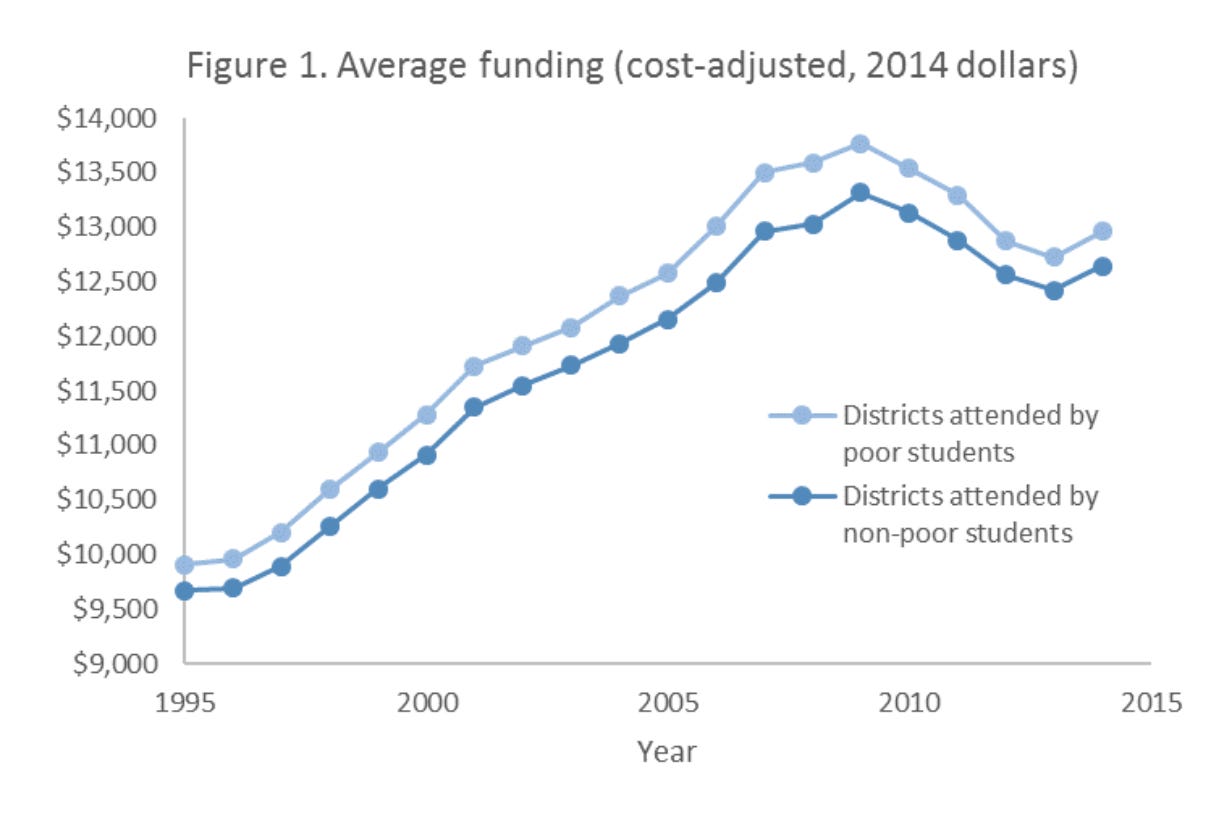
If you break this down by sources of funding, it becomes clearer that the lack of local funding for poor schools is being made up for by increased state funding.
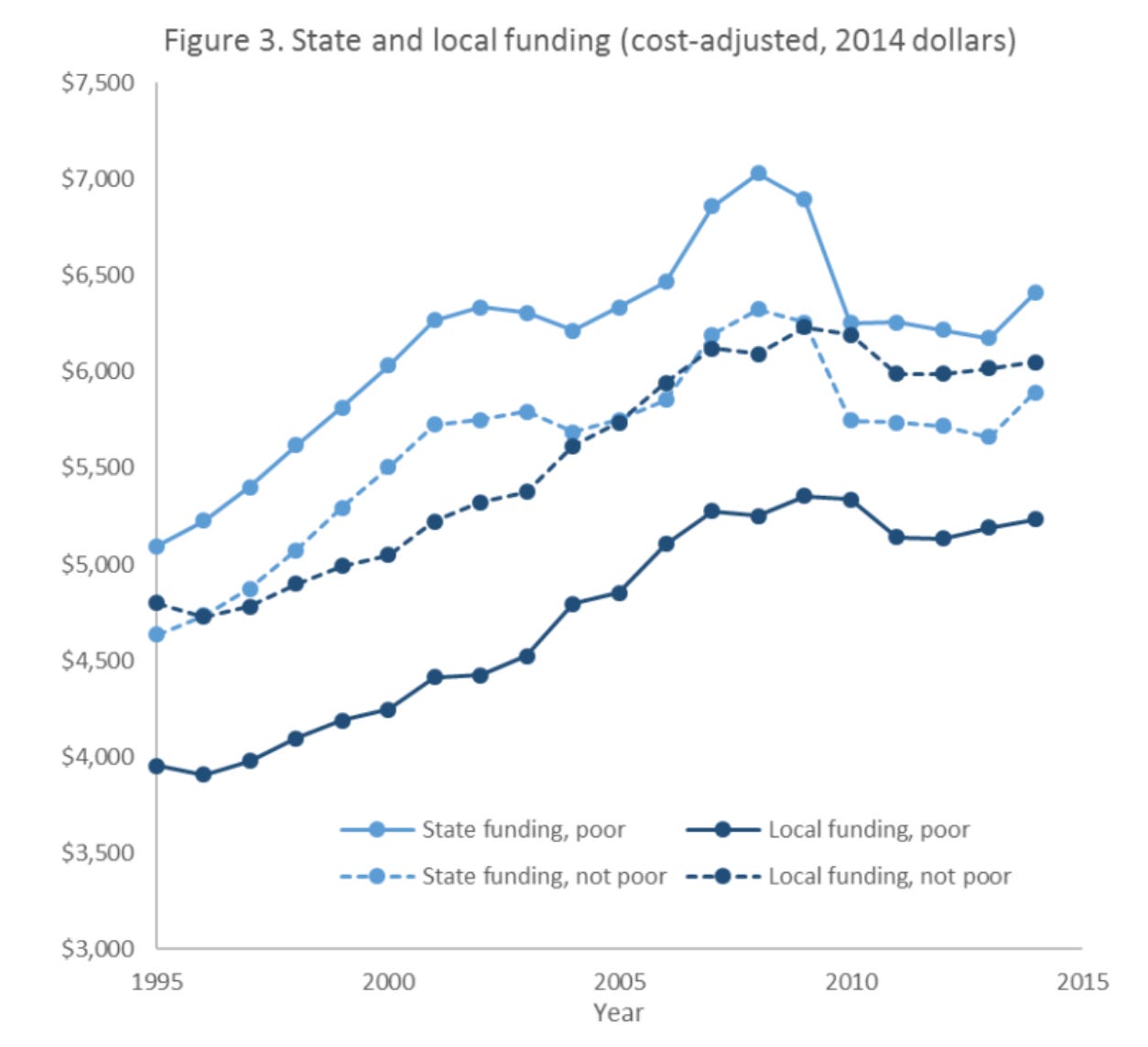
I suspect that many of the issues with American schools are actually downstream of bad teaching practices rather than insufficient funding. I’ve seen huge amounts of funding go to teaching practices that don’t replicably work. I’d very strongly recommend the podcast Sold a Story if you’d like an example of a catastrophic teaching practice that had huge amounts of funding behind it. Even very well-funded schools often have trouble forcing their teachers to teach phonics!
Real catastrophes§
Things I expected to be fake but turned out to be real.
“You can harm your eyes with too much screen time”§
It does seem like nearsightedness has grown over the years as more people use screens. This seems to result from the screens (and books, and other things we look at) being too close, rather than the light from them. I expected this effect to be smaller than it was.
I’ll circle back and add to this as more come to me.
I own a 2015 Corolla which gets ~32 MPG highway. US average emissions per gallon is 8.887 kg CO₂/gal. Trip is ~440 miles. (440 miles) x (1 gallons / 32 miles) x (8.887 kg CO2 / gallons) = 122 kg CO2.
Emissions for short-haul flights average 154 g CO2 per passenger km. It’s ~700 km by air from DC to Boston.